AI-native Kaizen · a global industrial-instrumentation manufacturerTerritory
Triage what's worth it. Expand what's already there.
This was a disciplined, well-run sales organization — not one in trouble. What moved was the benchmark. Inference made it practical to model the whole opportunity landscape and aim every seller-hour at where the company actually wins — turning pursuit and expansion calls that used to ride on tenure and gut into decisions grounded in a shared model. We built that surface inside the kaizen, and left it running.
- right-to-play capture / seller-hour
- Multiplier
- direct funnel in the crosshairs
- $30M
- both halves of every touch
- Triage × Expand
- re-weighted by every call
- 1 model
Figures illustrative & directional · client generalized · validated reference implementation, grounded in seller interviews
01 · Where it started
Two questions burn every seller-hour.
A seller spots a project. Immediately: is this worth my time, and what's my way in? The answer lived in tenure, scattered spreadsheets, and gut feel — so hours went to deals that never had a right to play, and the expansion hiding inside a won deal walked out the door unseen. None of this was a failure of effort. It was waste that only became visible — and only became fixable — once the work was modeled as one system, with inference in the loop.
Wasted hours
Time poured into projects with no distinctive advantage — busywork that felt like pipeline.
Cold entries
No read on the warmest relationship into an account, so sellers led with strangers, not champions.
Missed expansion
Adjacent needs, sister sites, and other stakeholders sat one question away — and the question never got asked.
02 · The governing move
Every touchpoint has two halves.
Triage qualifies fast and honestly — pursue or park, always with a reason. Expand serves the need first, then grows it — adjacent needs, other sites, new people, reached through the warmest way in. Take a real project through both.
Spotted project
Hyperscale AI campus · gray-space build-out
Start with triage — the model won't let you expand a project you haven't qualified.
03 · Steered to where you win
Not every need is a right to play.
The model sorts every need into three tiers so the seller leads with strength, displaces deliberately, and never burns credibility chasing a need with no product behind it. Pick a need on the project.
Power quality analysis
A distinctive strength with the documentation trail buyers standardize on. This is where the company wins outright.
The steer
Lead with it — anchor the whole conversation here.
04 · The world-model
A living graph, not a static CRM.
The market and the company's relationships live as one traversable graph — accounts, projects, people, and the needs that connect them. It knows how warm each relationship is, so "the way in" is a query, not a guess. Click a rung.
You are trusted with the commissioning agent — the warmest way into this owner, and the path the model recommends first.
In the room
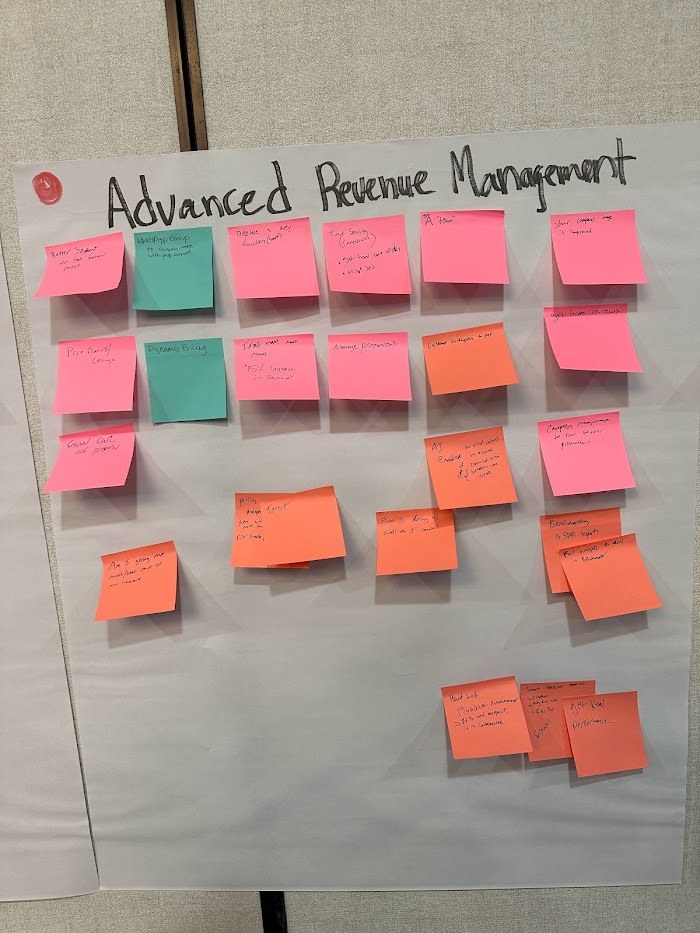
Territory planning, at the whiteboard.
The seller surface didn't start as software. It started here — the team mapping accounts, the way in, and where the company actually wins, before a line of the model was built. The tool encodes what the room already worked out.
05 · Why it compounds
Every verified call makes the next one sharper.
Capture is forced-verify: the seller confirms what's actually true before it's saved. That truth re-weights the model — so the next seller's triage starts from evidence, not lore. The multiplier compounds across the team.
Verified
The gray-space GC controls the test-equipment spec → warm-path weighting raised for GC contacts on similar builds.
Verified
Owner standardized single-vendor after commissioning → power quality confirmed as core right-to-play for this segment.
Logged loss
Lost fiber OTDR on price → competing tier reaffirmed; a bundle play was added to the pre-call plan.
06 · The redesign you own
The app is the playbook, made tangible.
Nine written standard works chain into one seller surface across six moves. Each screen renders a standard work and is scored by its rubric. Edit the playbook and the surface changes — orchestration over automation. We built it with the team, in the kaizen — a working surface, not a slide of recommendations — so what stayed behind was a running system they own. The process is the asset; the pipeline is the byproduct.
Intake
Account research · BOM triage
Pre-call plan
Engagement · stakeholder triage
Expansion
Post-call · kaizen review
07 · The objective
More right-to-play capture, per seller-hour.
That's the whole objective — the opportunity multiplier. The same hours, aimed only where the company wins, with the expansion made visible and the model getting smarter every week. The target it's pointed at: a $30M direct funnel.
Right-to-play capture / seller-hour
Illustrative — the shape of the change, not a measured result.
Why bring in a guide
New to everyone. The best reach outside.
AI created a new class of process waste — and the capability to see it is new to everyone. That is the moment the most disciplined operating cultures reach outside, the way lean itself entered the West: through a sensei, learning by doing, then making it their own.
Elynox descends from the same lineage the great business systems do — the Toyota Production System, the Danaher Business System, and their branded descendants — and has applied that discipline (value streams, standard work, kaizen) to AI-native redesign since these capabilities went public, across hundreds of processes at multi-billion-dollar operating scale. Your system isn't obsolete; AI is the next frontier it was built to conquer. It just takes a guide who has already mapped the terrain — the title that tradition reserves for a master.
The takeaway
We didn't hand them a lead list. We handed them a way to see.
A seller surface that triages honestly, expands what's already there, steers to where the company wins, and sharpens itself with every call — the playbook the team owns, running.