AI-native Kaizenfor companies that run on human expertise
Is there opportunity hidden inside the advantage your people have spent decades building?
Problems are the opportunities continuous improvement has always aimed to find; artificial intelligence opens new paths to solve them. We help your domain experts map the paths, prototype the AI-native redesign, and leave it running in your operators’ hands within the week.
- Real capability separated from hype, and named where it changes your processes.
- Further in sight
- Several redesigns of one process, compared, with the safest tested first.
- Further in route
- The habit of finding and adopting better methods stays after we go.
- Further in capability
A blurred problem definition puts the best target further away.
The structure holds. A goal is still a terminal state, a path is still a trajectory toward it, and breaking the goal down is still plotting the course for expert navigation.
When there is a shorter path and it goes unseen, the work reaches the target the long way: more cycles, more handoffs, more motion. That distance is the waste, and shortening it is the whole exercise.
The bedrock of competitive advantage, built on decades of lessons learned, may now erode in ways the controls that protect it were never built to catch. Your experts can read any ground they are given; a new vantage is what brings the rest into view.
Ours is a vantage on the work itself: each step read for what should perform it. From there, new paths open in five places.
Rework from context that never arrived
Context lives with whoever has it, so every handoff re-explains it and some of it does not survive.
The same problem, solved twice
The method never left the person who has it, and the answers sit in documents nobody re-checks, so the same question gets researched again.
Judgment spent on retrieval
Senior people spend the day finding documents and checking consistency, work that nothing in the process can execute for them.
Review at the end of the line
Inspection sits after assembly, where a defect costs the most to pull out, and nothing checks the work as it is made.
Work waiting on attention
Capacity is how much a person can hold at once, and everything else waits its turn behind that.
With the problem defined at full resolution, better targets come within reach. A week on a process worth millions, run by the experts who already navigate it, with capacity the redesign hands them, is the largest stretch a business system can take.
The job is leaving the redesign runnable by the people who sustain it.
What actually changed
Expertise is knowing which way to go, and knowing it early.
Decades in a craft are ground covered: most routes ruled out on sight, by someone who has been down enough to know where they end. That is experience earned, and it is what recognizes a shorter path when one appears.
Tacit knowledge had a channel
People absorbed the unwritten parts over years alongside each other. A model gets no apprenticeship, so what stayed unwritten does not arrive.
Options that were never worth costing
Reading every page of a 5,000-page intake was never worth the hours when a sample would do. The trade-off is worth re-pricing.
Judgment scales once encoded
An expert notices a better way without being told. Written down, that noticing runs on every case instead of one.
Mastery of the work stays with the people who hold it. Ours is the translation: turning what an expert does into logic a model and a person can both run, across several hundred processes. Their standard decides what ships.
Why now, not later
Waiting for AI-native redesign to grow in-house is its own decision.
The people who know where the work slows are already inside the business. What has not had time to form is the practice of drawing their judgment out and encoding it.
Every quarter a redesign runs is a quarter of compounding the business keeps
The craft
Two disciplines, and the work needs both.
The first discipline is standard work, value stream mapping and kaizen events, run once through at the process and closed with a standard. The second is reading those instruments against what software can now execute.
An event runs at the process, with the operators leading and our hands off the work. It closes on a standard, and whether that standard spreads sideways is the operators’ call.
Much of the event is questions: what the operators ask, why they ask it, and what they do with the answer. The answers carry judgment nobody had written down.
The reading is where the judgment sits. Retrieval, synthesis and consistency checking hand over to a model. Judgment, exceptions and consequence stay with people, and we argue for that even where full automation would look better in a report.
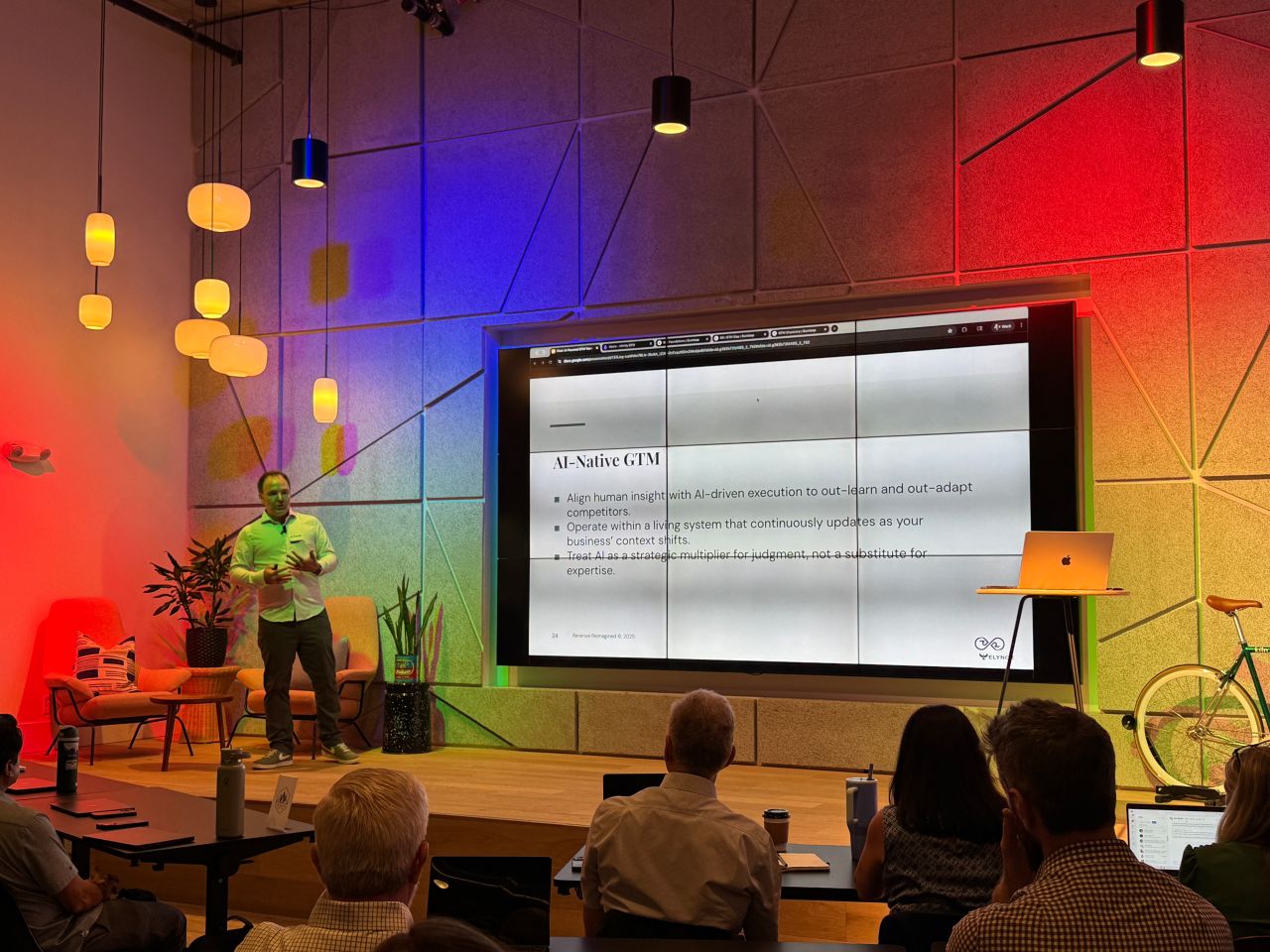
photographed on a live engagement
The engagement
A Kaizen, pointed at one commercial process.
Your operators lead, the work happens where the process runs, and it does not close until the redesign does.
Step one
Walk it
We watch the process run as it actually runs, including the parts nobody wrote down.
Step two
Name the waste
Your experts locate each category in specific steps, with the evidence attached.
Step three
Redesign it AI-native
Your experts draw more than one candidate route, test the one carrying least risk, and let the measurements pick the standard.
Step four
Leave it running
The event closes with a report-out and a standard, and the redesign runs on your systems before anyone goes home.
You keep a working redesign of the process.
The redesign has the improvement loop built in, so it keeps getting better after we go. A later revision discards nothing already learned.
It runs where you work
On your systems, under your controls, run by the people who built it.
The method becomes the team’s
What one person knew how to do can now be done twice, by someone else.
The work gets lighter
The next step is obvious to whoever picks it up, which is what keeps a redesign in use.
What we use to keep track of it
The process, held as a working map.
The map shows what is verified, what is only connected, what is unexamined, and which candidate route the evidence favors.
You do not need it to run what you keep
The improvement record
Improve the process daily. Redesign it when the evidence demands it.
The discipline engineers use on any controlled system, applied to a process: run it, plot its state, improve the policy, run it again. Play a week to watch the trajectory. Press Redesign to change the system itself, and the whole curve steps down.
Retire the waste. Keep the learning. Raise the standard.
Improve each run · redesign when the curve flattens · never final
The work
Found and fixed, again and again.
A B2B software company
A demand motion, rebuilt one to one
A one-to-many motion rebuilt so each account gets individual treatment. Nine artifacts the team owns, six accounts live, a full kit in 27 minutes.
A precision manufacturer
Knowledge that stays current
A document vault rebuilt so answers come from one reviewed source. Corrections sharpen it instead of piling up beside it.
A safety-equipment maker
A 5,000-page intake, made routine
Five stages of RFQ intake redesigned. An eight-hour extraction no longer runs, and a junior engineer can carry a bid that needed a veteran.
The mechanisms are real and we will walk you through any of them. Figures are directional; operating numbers stay with the client.
the objective, unmoved · the loop, reopened
This is the next frontier your business system was built to conquer.
It takes a guide who has already mapped the terrain. Pick the process you suspect, and we will show you what is in it and what it looks like redesigned.
Continuous improvement, punctuated by intelligent reinvention.